
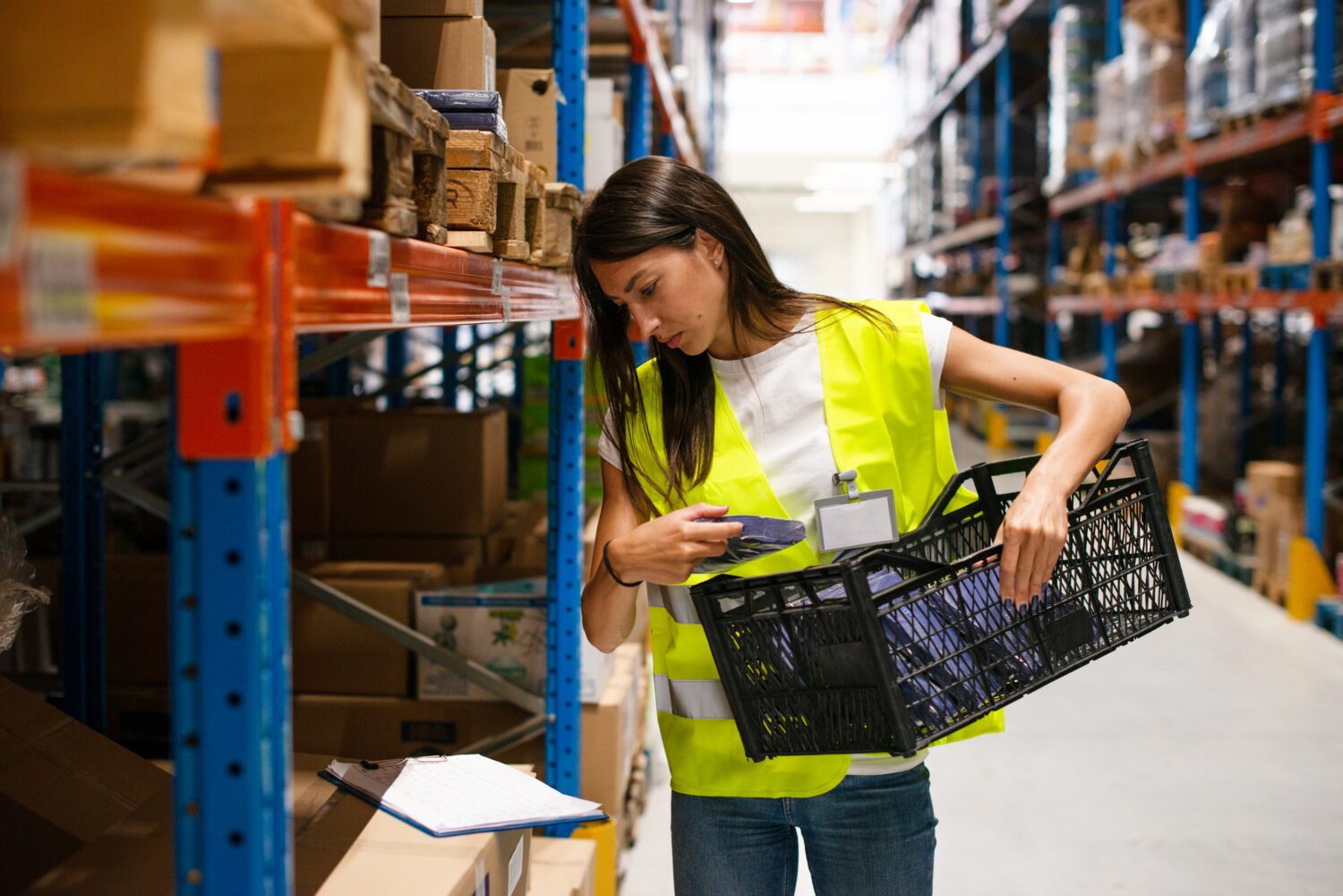
Picking drives every order that leaves a warehouse. It connects storage to the packing line and ultimately to the customer's door:
- When picking runs well, orders ship faster, costs stay lower, and accuracy improves.
- When it breaks down, the entire fulfillment chain feels it – from returns and reshipments to missed delivery windows.
Understanding the different picking methods available and how to optimize them can help operations teams turn one of the most labor-intensive warehouse activities into a competitive advantage.
Is the Picking Process in Logistics?
Picking is the process of selecting and retrieving products from warehouse inventory to fulfill customer orders. It involves several core steps:
- An order comes in and the team verifies customer details, payment, and stock availability.
- Order pickers travel to designated storage positions to locate the inventory.
- They select the correct items and quantities.
- From there, items move to the packing area for shipment preparation.
Each of these steps feeds directly into the next, and a breakdown at any point can delay the entire fulfillment cycle.
Order pickers spend the majority of their time traveling through the facility searching for products, which makes picking one of the most labor-intensive warehouse operation activities.
Every item pulled from a shelf adjusts the facility's stock levels. That makes reliable average inventory calculations dependent on what happens on the warehouse floor. Not surprisingly, errors in the order picking process can compound quickly. A wrong pick can lead to a wrong shipment, which triggers returns, reshipments, and added costs.
Where Picking Fits in the Warehouse and Logistics Workflow
Picking follows a defined sequence in the fulfillment cycle:
- The warehouse receives an order and verifies customer info, payment, and stock availability.
- An order picker retrieves items from storage.
- The packing team packages, labels, and completes shipping documentation.
- The order dispatches to the carrier.
This sequence runs on a fixed timeline, and any delays at the picking stage can push back every step that follows.
What happens before picking matters just as much. Receiving and putaway determine product slotting; poor putaway can mean longer pick paths and slower warehouse picking.
What happens after picking matters too.
A wrong item picked can mean a wrong item shipped, which can trigger returns. Warehouse order accuracy at the picking stage determines whether downstream processes run smoothly or create costly bottlenecks.
Picking must also align with carrier schedules and outbound dispatch windows. Coordination between warehousing and distribution helps keep the entire chain moving on time.
Common Types of Picking Methods
Warehouses use several picking methods depending on volume, layout, and order complexity.
1. Single Order Picking
The picker handles one fulfillment request at a time and travels through the entire warehouse for each order. This method is slower, but high accuracy makes it ideal for low-volume operations.
2. Batch Picking
Multiple orders are picked simultaneously, with each picker focusing on a single item category. This reduces travel because the picker visits each storage location once instead of making multiple trips.
It works best when multiple orders call for the same products. Each unique product in a warehouse carries a stock keeping unit (SKU) – an identifier used to track and differentiate items. Warehouses with fewer SKU numbers see more overlap between orders, which lets batch pickers visit one location and pull for several orders at once.
3. Zone Picking
The warehouse divides into sections, and pickers stay assigned to specific zones. This is best for high-volume orders containing many products.
4. Wave Picking
Orders release in scheduled time windows, prioritized by shipping deadlines. Items get pulled in order of priority based on transportation timelines.
5. Cluster Picking
The picker completes multiple orders at once, choosing a wide range of goods for each. The most common practice involves pushing a cart full of containers from location to location.
6. Case Picking
Pickers select full cases or cartons from pallet positions, carton flow racks, or shelving. Faster-moving items often come from pallet placements, while low-turnover items come from stationary shelves.
7. Discrete Picking
Pickers select individual items one at a time until the order is complete. It’s simple to implement and easy to monitor picker precision.
How to Choose the Right Picking Strategy
No single order picking method works for every warehouse. The right selection depends on a facility's operational profile.
Several key factors drive the decision:
- Order volume and velocity: High-volume operations may need zone or wave picking, while low-volume facilities can use single order.
- SKU variety and size: A wide product range favors zone picking, and a narrow range favors batch.
- Labor availability: Warehouses with limited staff benefit from methods that reduce travel time.
- Warehouse layout: Facility size, aisle configuration, and storage types dictate which methods are practical.
- Customer delivery expectations: Tight service-level agreements (SLAs) may require wave picking tied to carrier schedules.
Some warehouses combine approaches – zone-batch, zone-wave, or zone-batch-wave – to handle more complex operations. Regardless of the method, the goal stays the same: minimize travel time, maximize picks per hour, and maintain accuracy.
Technologies That Improve the Picking Process
A warehouse management system (WMS) can help generate automatic picking lists, optimize picking routes, and direct workers to their next task. It can also keep inventory updated in real time as orders move through the facility.
Several tools build on that foundation:
- Barcode scanning: Pickers scan to confirm the correct item; the system updates stock levels and order progress instantly.
- Radio frequency identification (RFID): Inventory is precisely tracked without manual scanning.
- Pick-to-light: Light-emitting diode (LED) indicators guide pickers to correct items, shortening picking time.
- Voice picking: Hands-free audio prompts direct pickers to locations, freeing hands and eyes for the task.
- Mobile scanning: Handheld devices verify orders in real time and eliminate manual pick errors.
- Automated picking and robotics: Collaborative mobile robots assist pickers in staying organized and minimizing errors.
Each of these tools works best when paired with a WMS, giving pickers and managers a single system to coordinate tasks, confirm accuracy, and track performance.
Common Challenges in the Picking Process
Even well-run warehouses face recurring picking challenges:
- Mispicks and wrong quantities: Similar packaging, mislabeled bins, and manual error can all contribute to sending the wrong product or incorrect count to packing.
- Labor fatigue: Preventable strains and injuries can result from doing the same actions repeatedly, particularly with large materials. In addition, fatigue later in shifts can contribute to more frequent errors.
- Training gaps: Without standardized procedures, workflows can vary from picker to picker.
- Poor slotting and layout: When products are scattered about the warehouse, workers spend time just looking for them.
- Inventory inaccuracies: The system says an item is in one location, but it has moved or gone out of stock. This can lead to delays, partial shipments, and backorders.
- Peak season bottlenecks: Volume spikes can overwhelm standard picking capacity, and without scalable labor and systems, backlogs can build quickly.
Most of these issues trace back to the same root causes: inconsistent processes, poor organization, and limited visibility into real-time inventory.
Best Practices for Optimizing Picking Operations
Several proven practices can help warehouses improve picking performance:
- Slotting optimization: Position high-velocity items near the packing area and place commonly requested items near one another. This minimizes movement and creates more efficient picking routes.
- Clear labeling and signage: Bin labels, aisle markers, and zone identifiers help pickers locate items without guessing.
- Training and standardized workflows: Establish consistent procedures across all pickers and schedule regular refreshers to keep execution tight.
- Route refinement: Check in with pickers regularly to learn what slows them down. A WMS can help optimize picking routes and schedule tasks to minimize downtime and travel.
- Key performance indicator (KPI) tracking: Measure picks per hour, error rate, and order cycle time to drive continuous improvement through measurable benchmarks.
- Ergonomic considerations: Use trolleys and conveyor belts wherever possible and place everything at a safe height. Allowing pickers to pause and stretch during shifts can help reduce fatigue and errors over time.
The common thread across all of these is consistency. Small improvements applied daily add up to measurable gains in speed, accuracy, and cost.
How Picking Impacts Customer Satisfaction
Picking accuracy sits at the foundation of the customer experience. No amount of fast shipping fixes the wrong item in the box. Every mispick can trigger return processing, a replacement shipment, and added cost. Returned items must then go through receiving, inspection, reshelving, and reentering the inventory cycle.
Consistent warehouse order picking accuracy can help build brand loyalty, while repeated errors can erode trust. For operations bound by service-level agreements, picking performance plays a direct role in the ability to meet contractual delivery commitments.
How Third-Party Partners Support Efficient Picking and Fulfillment
Picking is both a cost driver and a value creator. The right combination of people, processes, and technology can pay off in faster fulfillment and fewer errors.
Third-party providers can help eliminate the guesswork of building a picking operation from scratch. Professional pick and pack services typically offer:
- Warehouse layout and workflow design optimized for picking efficiency
- Scalable labor and systems that flex with seasonal volume
- Accuracy-focused fulfillment models with real-time inventory tracking
- Integration with distribution and transportation for end-to-end logistics
- Support for both business-to-business (B2B) and business-to-consumer (B2C) picking method requirements
Outsourcing picking to an experienced partner can help reduce labor costs and shipping errors. In addition, smarter picking strategies can help transform overall warehouse performance from a cost center into a fulfillment advantage.
Midwest AWD helps businesses build faster, more accurate picking operations backed by scalable systems and end-to-end logistics support. Contact our support team today for a free consultation.